- Technology
- /
- ORC
Organic Rankine Cycle system
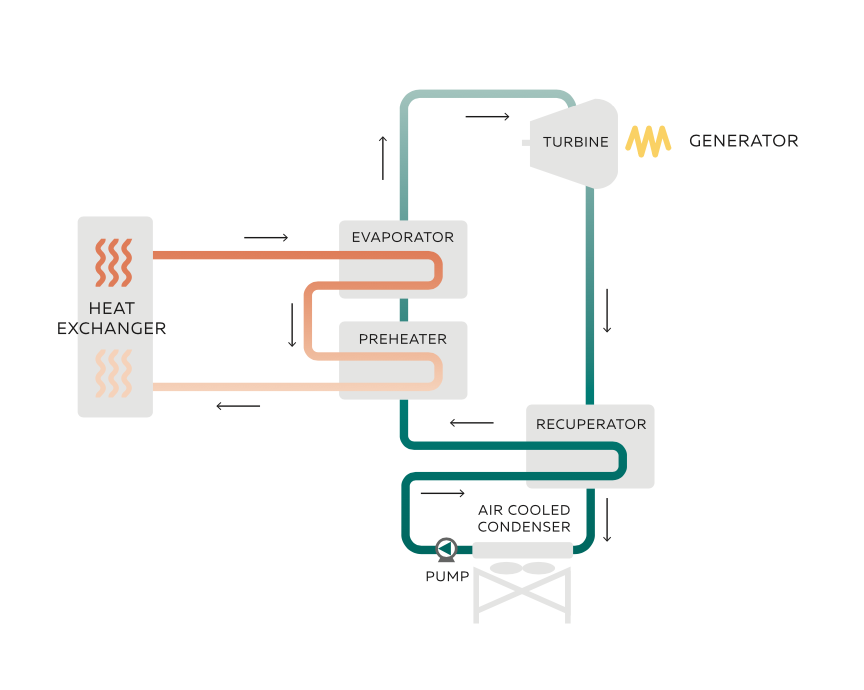
An Organic Rankine Cycle (ORC) system is a closed thermodynamic cycle used for power generation from low to medium-high temperature heat sources, typically ranging from 80 to 400°C, and for small-medium applications at any temperature level. Consisting of four key components—the ORC turbine, the heat exchanger, the condenser, and the feed pump—ORC technology enables the efficient utilization of low‑grade heat that would otherwise be wasted.
Exergy introduced a major innovation in this field. While axial and radial‑inflow turbines had been used for decades, Exergy utilized the Radial Outflow Turbine (ROT), applying this highly efficient technology across a wide range of customized ORC power plants and delivering additional performance advantages.
Exergy’s expertise in tailor‑made ORC systems is supported by a portfolio of 600 MWe installed. In addition to its customized solutions, Exergy also offers a standardized ORC product series.

PRODUCE CLEAN AND AFFORDABLE ELECTRICITY FROM A WIDE RANGE OF HEAT SOURCES WITH THE ORGANIC RANKINE CYCLE.
The Organic Rankine Cycle
The working principle of an Organic Rankine Cycle power plant is similar to the most widely used process for power generation, the Clausius-Rankine Cycle.
The main difference is the use of organic substances (hydrocarbons or refrigerants) instead of water (steam) as working fluid.
The organic working fluid has a lower boiling point and higher vapor pressure than water and is therefore able to use low-medium temperature heat sources to produce electricity more efficiently than steam cycle.
The organic fluid for the cycle is chosen for best fit with the heat source according to their various thermodynamic properties, thus obtaining higher cycle and expander efficiencies.
The main components
of an Organic Rankine Cycle power
plant include:
1
THE ORC TURBINE
This is the key component of the entire ORC power plant and determines ORC system performance. It expands the working fluid, producing mechanical energy that is converted into electricity by a generator coupled with the turbine shaft.
2
THE HEAT EXCHANGERS
The organic Rankine cycle working fluid flows through the heat exchangers, extracting heat from the heat source. Shell and tube heat exchangers are usually applied but they can vary in terms of geometry and configuration depending on the energy source and total thermal input.
3
THE CONDENSER
With the direct air to fluid heat exchanger, the organic fluid is cooled and liquefied before entering the pump. The use of air eliminates the need for water treatment and makeup. It is also possible to use a water-cooled condenser.
4
THE FEED PUMP
Brings organic fluid from the condensation pressure to the maximum pressure of the Organic Rankine Cycle. The pump is usually driven by an electric motor at variable rotating speed.

Organic Rankine Cycle applications
By converting thermal energy to electricity from low to medium-high temperatures, ORCs are suitable for a wide range of applications, given a ORC plant size between 100 kW ad 50 MWe, including:
Organic Rankine cycle vs Rankine cycle: learn why ORC cycles are more competitive and flexible
1
SUITABLE FOR LOWER TEMPERATURE APPLICATIONS WITH DIFFERENT ENERGY SOURCES

Suitable for a wider range of applications worldwide
2
NO LIQUID PHASE DURING EXPANSION

Reliable and long-lasting expander

Simpler and lower maintenance costs
3
COMPACT AND AUTOMATED

No need for operators
4
MODULAR CONFIGURATION

Ease of transportation and installation

Low environmental footprint

Reduced land occupation

Low associated costs for foundation and assembly
5
DESIGN FLEXIBILITY FOR USE OF THE MOST EFFICIENT WORKING FLUIDS

Optimized efficiency

Customized solution with respect to resource
6
OPERATIONAL FLEXIBILITY

Superior off-design performances
7
NO-WATER CONSUMPTION OPTION

Lower environmental impact with no waste of water

No water treatments required

Wider application also in remote areas
8
SIMPLE, FAST AND RELIABLE SYSTEM MAINTENANCE

Long product life

Ideal for cycling environments and where fast start stops are required
9
HIGH MARKET AVAILABILITY OF CHEMICAL WITH FLUID REFILLING RARELY REQUIRED

Lower operating costs
History of Organic Rankine Cycle
Over the past two decades, the Organic Rankine Cycle market has experienced substantial growth, establishing itself as the preferred technology for geothermal power plants. This trend is expected to continue, with ORC market value projected to reach USD 1,290.9 million by 2033 and a CAGR of 4.7%. The increasing urgency to enhance energy efficiency and deploy decarbonization technologies will further accelerate the adoption of ORC systems for waste heat recovery across multiple industrial sectors.
The use of ORC expands rapidly, especially for biomass and geothermal applications, leaving great margin for growth in WHR and solar thermodynamic applications.
THE FINNISH SCHOOL
In Finland, Prof. J. Larjola leads the development of high-speed hermetic turbogenerators in the hundreds of kWe range, in which the turbine, generator and pump share the same shaft. One of the first applications of this type of ORC turbogenerator was charging the batteries of a deep-sea submersible (1987).
Prof. G. Angelino, together with Ennio Macchi and Mario Gaia start Italian research activity in the ORC sector at Politecnico di Milano. They begin studying the possibility of using organic fluids instead of water to power the Rankine Cycle for automotive, space and solar applications.
Collaborating with Prof. d’Amelio, who first designed a power plant using ethyl chloride to power a turbine, Società Anonima Forze Endogene Napoletane (SAFEN) installs a 300 kWe geothermal plant on Ischia Island (Italy). This plant became operational in 1955 and was the first modern binary plant worldwide.
Prof. Luigi D’Amelio employs an organic fluid in a real turbine system. He is also the first to consider the advantages of high molecular mass fluids to reduce rpm and the number of turbine stages.
Frank Ofeldt develops a power system engine that uses naphtha instead of water.
Prof William John Macquorn Rankine develops a complete theory of the steam engine describing how power can be generated from the temperature difference between a heat source and a cold source and idealizing the thermodynamic cycle that then took his name: Rankine Cycle.
Nicolas Léonard Sadi Carnot publishes Reflections on the Motive Power of Fire, in which he expresses the first successful theory of the maximum efficiency of heat engines, laying the foundations for an entirely new discipline: thermodynamics.